
If you are a skincare enthusiast, chances are you have already come across double cleansing, essences, and glass skin as hallmarks of the beloved Korean beauty routine. But if you are ready to level up your glow game, there is one specific technique that has been quietly revolutionising skincare routines worldwide and is now firmly established as a 2026 favourite: the 4-2-4 rule.
At first glance it might sound like a locker combination, but the 4-2-4 rule is a luxurious, highly effective facial cleansing ritual that originated in South Korea and has since earned a devoted following across the globe for its simplicity, its science-backed benefits, and the very real results people are seeing in their skin. In 2026, with dermatologists and skincare experts increasingly emphasising slow, intentional skincare over quick fixes, this method has never felt more relevant.
In this guide we break down exactly what the 4-2-4 rule is, how it works, what the science actually says about it, how to adapt it for your skin type, and how to incorporate it into your routine without making it feel like another chore. Let us get into it.
What Is the 4-2-4 Rule in Skincare?
The 4-2-4 rule is a cleansing technique developed by K-beauty experts that involves three main steps carried out over ten minutes total.
The first four minutes are dedicated to oil cleansing. The following two minutes are spent on a foam or cream cleanser applied directly over the oil. The final four minutes are spent rinsing thoroughly. The name comes directly from the number of minutes you dedicate to each step: 4, then 2, then 4.
This is not just a cleansing method in the way we usually think about washing our faces. It is simultaneously a facial massage, a skin detox, and a mindfulness ritual rolled into one. When done consistently it is designed to remove deep-seated impurities and makeup, stimulate blood flow to the face, boost hydration and product absorption, and leave skin feeling softer, more radiant, and genuinely balanced.
Where Did the 4-2-4 Rule Come From?
Like many brilliant beauty methods, the 4-2-4 rule has its roots in Korea, where skincare has long been considered not just a routine but a form of self-care and self-love rather than a mundane task to rush through. The method builds on the double cleansing philosophy that K-beauty popularised globally, but adds a time-focused, meditative element that encourages real intentionality in the cleansing step.
It became widely known through K-beauty brands like Whamisa and Su:m37 and has since become a reference point in discussions about thorough, barrier-friendly cleansing around the world. In 2026, with the broader skincare industry moving firmly towards longevity focused routines and the concept of slow beauty gaining real traction, the 4-2-4 method fits the cultural moment perfectly.
Why Does Cleansing Matter This Much?
Before getting into the steps, it is worth pausing on a question that skincare beginners often ask: why does cleansing deserve this level of attention?
Many people rush through cleansing or use a single quick lather. In truth, cleansing is the most critical step of any skincare routine. It is the foundation upon which everything else rests. If your skin is not properly cleansed, serums and creams cannot absorb properly, pores become congested with layers of dirt, sebum, and sunscreen residue, breakouts and dullness become more likely over time, and your skin barrier can gradually become compromised.
Research published in dermatology literature has found that even after a single cleanse, traces of sunscreen, particularly water-resistant formulations, remain on the skin surface. A secondary oil-based cleansing step has been shown to remove these residues more effectively and with less dryness and irritation than using a standard foaming cleanser alone. This is one of the genuine science-backed arguments behind the 4-2-4 method, as opposed to the exaggerated detox language that sometimes surrounds it online.
When K-beauty recommends spending ten full minutes on cleansing, the reasoning is not dramatic for its own sake. It is about giving each step enough time to actually work.
What the Science Actually Says in 2026
It is worth addressing this honestly because in 2026 there are both genuine enthusiasts and genuine sceptics of the 4-2-4 method, and both have points worth hearing.
The useful, evidence-backed core of the method is the double cleansing principle. An oil-based first cleanse dissolves oil-soluble impurities including makeup, sebum, and sunscreen in a way that a water-based cleanser cannot do alone. The follow-up water-based cleanse then removes those dissolved impurities along with any water-soluble residue. The combination addresses both oil and water-based impurities in a way a single cleanse simply cannot.
The extended rinsing step is also more grounded in reality than people expect. Most people rinse for less than 30 seconds, leaving product residue on the skin that can clog pores and interfere with the absorption of everything applied afterwards. Four minutes of rinsing, particularly with a lukewarm-to-cool water transition, gives cleanser residue time to fully emulsify and lift off the skin surface.
Where the method attracts legitimate criticism is in the rigid timing and the language that sometimes surrounds it. The specific numbers 4, 2, and 4 are not the result of clinical research. They are guidelines designed to encourage thoroughness, and the evidence does not suggest that four minutes of oil cleansing is meaningfully better than two and a half minutes of oil cleansing. The massage technique matters more than the stopwatch. Similarly, the “detox” language used in some descriptions overstates what cleansing does at a cellular level.
The honest 2026 summary is this: the principles behind the 4-2-4 method are genuinely sound. The precision of the timing is more about building a habit of care than scientific exactness. Used with appropriate products and the right technique, it works. Approached with a stopwatch and taken too literally, it becomes unnecessarily rigid.
Breaking Down the 4-2-4 Method Step by Step
Here is exactly how to do this at home, with updated product recommendations for 2026 and guidance on technique.
Step 1: 4 Minutes of Oil Cleansing
You begin with an oil cleanser, massaging it gently into dry skin for four minutes. This is the heart of the method and the step where most of the heavy lifting happens.
Oil dissolves oil. This is fundamental chemistry and it is why an oil cleanser is uniquely effective at breaking down the layers of makeup, sunscreen, pollution, and excess sebum that accumulate on the skin surface throughout the day. A water-based cleanser alone will struggle to cut through these oil-soluble residues without stripping the skin.
To do this step correctly, apply two to three pumps or a coin-sized amount of your chosen oil cleanser to completely dry hands and then to dry skin. Massage in slow, circular motions across the face, paying particular attention to the T-zone, the sides of the nose, the chin, and any areas where you tend to get congestion. Use upward strokes rather than downward ones to support circulation and avoid contributing to any loss of skin firmness over time.
This is also the step where facial massage can be incorporated if you choose. Gentle circular movements support lymphatic drainage, which can reduce puffiness and contribute to a more defined appearance around the jaw and eye area over time. If you use a gua sha tool, this is the natural moment to incorporate it after the oil cleanser has created a slip on the skin surface.
Do not rush this step. The four minutes feel long at first and become meditative once they are a habit.
2026 product recommendations for the oil cleanse:
The Ma:nyo Pure Cleansing Oil has been consistently praised by estheticians and editors in 2026 for its ability to remove makeup and SPF without leaving a film behind. It is lightweight and does not interfere with product absorption in subsequent skincare steps. The DHC Deep Cleansing Oil remains a classic recommendation for good reason and is widely available across the UK. For those who prefer a balm texture over a liquid oil, the Then I Met You Living Cleansing Balm has emerged as a standout in 2026 with a buttery formula containing sea buckthorn oil for hydration and persimmon extract for brightening. Banila Co Clean It Zero is an excellent mid-price option available at Boots and ASOS that suits most skin types including oily skin.
Step 2: 2 Minutes of Foam or Cream Cleansing
Without rinsing off the oil cleanser, you now apply your second cleanser directly on top of it.
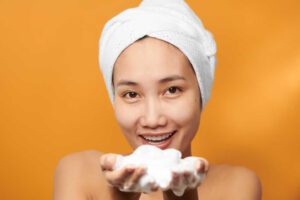
This step is where the two cleansers work together. Adding a small amount of water to your hands allows them to lather slightly, and then you apply your foam or cream cleanser on top of the oil still on your face. The combination emulsifies and lifts away the oil along with all the impurities it has dissolved, while the second cleanser addresses any surface-level water-based residue that the oil step cannot reach.
Massage for two minutes, concentrating on the creases and corners that are easy to miss: around the nostrils, along the jawline, the hairline, and the area just below the eyes. Keep movements gentle and avoid dragging the skin.
The product you choose here matters for your skin type. If you have oily or combination skin, a gel or foam cleanser with a slight purifying action works well. If you have dry, sensitive, or barrier-compromised skin, a cream or milk cleanser is a better choice as it will not strip the skin further after the oil cleanse.
2026 product recommendations for the second cleanse:
The KraveBeauty Matcha Hemp Hydrating Cleanser is one of the best balanced options available in 2026 for normal to combination skin, with a formula that cleans effectively without tipping the skin into dryness. La Roche-Posay Toleriane Hydrating Gentle Cleanser is the top recommendation for sensitive skin types and has become a consistent bestseller for good reason. CeraVe Hydrating Cleanser at around £13 remains one of the most recommended cleanser options by dermatologists for both dry and sensitive skin types and is available at every major UK pharmacy. For oily skin that needs a more purifying touch, the Neogen Real Fresh Foam Green Tea Cleanser provides gentle yet effective cleansing without over-stripping.
Step 3: 4 Minutes of Rinsing
Now it is time to rinse, and this is the step that almost everyone rushes and almost everyone should not.
Most people rinse their face for under 30 seconds. In that time, particularly if you are using circular motions in a rush, it is very easy to leave cleanser residue behind on the skin. That residue sits in pores, disrupts the skin barrier, and reduces the effectiveness of every product you apply afterwards.
Four minutes of thorough, methodical rinsing gives everything time to lift away completely. Begin with lukewarm water for approximately the first two minutes. Lukewarm water is optimal for emulsifying and removing cleanser residue without causing thermal shock to the skin or stripping moisture. After two minutes, transition to cooler water for the remaining two minutes. The cooler temperature supports the skin barrier, helps calm any redness, and gives the skin a refreshed, tightened feeling that is genuinely noticeable.
Use your hands rather than a cloth for rinsing. Cloths, particularly if they are not freshly laundered, introduce bacteria to the skin and can create friction that irritates a freshly cleansed skin surface. Pat dry with a clean, soft towel rather than rubbing. The skin is at its most receptive immediately after cleansing and rough towel movements can cause unnecessary irritation.
How to Adapt the 4-2-4 Method for Your Skin Type
One of the strongest arguments in favour of the 4-2-4 method in 2026 is how adaptable it is once you understand the underlying principles rather than following the steps too rigidly.
For dry or dehydrated skin: Choose a nourishing oil cleanser or a cleansing balm with hydrating ingredients such as squalane or sea buckthorn oil for the first step. Follow with a cream or milk cleanser rather than a foam for the second step. Keep your water lukewarm throughout the rinse and do not transition to very cold water, which can exacerbate dryness. Apply your toner or essence immediately after patting dry to lock in moisture before it can evaporate.
For oily or combination skin: A lightweight cleansing oil or a gel-oil hybrid works best for the first step and avoids the heaviness that some richer balm formulas can leave. Choose a gentle foam or gel for the second step with a pH-balanced formula. Oily skin benefits from thorough rinsing but be careful not to confuse thorough with harsh: the goal is clean skin, not stripped skin, and over-cleansing oily skin typically makes oil production worse rather than better.
For sensitive, reactive, or rosacea-prone skin: This is where the method requires the most personalisation. A full ten-minute cleanse with active massage may be too much for genuinely reactive skin. If you have sensitivity, start with a shorter version: two minutes of very gentle balm cleansing using a fragrance-free formula, one minute with a soothing cream cleanser, and two to three minutes of rinsing with lukewarm water only rather than transitioning to cool. Fragrance-free and low-irritant formulas are essential. If your skin is actively flaring or barrier-compromised, pause the method entirely until it settles.
For acne-prone skin: The oil cleansing step can feel counterintuitive if you have been told for years that oil will cause breakouts. In reality, the right oil cleanser used correctly and followed by thorough rinsing should not clog pores. The key is to use a non-comedogenic formula and to ensure the rinsing step is genuinely thorough. If you find that your skin purges or breaks out more during the first two weeks, reduce frequency rather than stopping entirely and assess whether your product choice needs adjusting.
What Should You Apply After the 4-2-4 Method?
The 4-2-4 method creates a perfectly clean, product-receptive canvas, and what you apply next matters just as much as the cleansing itself.
Immediately after patting dry, apply your toner or essence while the skin is still slightly damp. This is when the skin is most absorbent and a hydrating toner or essence applied at this moment delivers noticeably better results than when applied to fully dry skin. If you use a hyaluronic acid serum, this is the moment to layer it.
Follow with any treatment serums, vitamin C in the morning or retinol in the evening, then lock everything in with your moisturiser. If it is your morning 4-2-4 routine, which is less common but some people do incorporate a shortened version in the morning, finish with an SPF.
In the evening after using the 4-2-4 method, a richer moisturiser or a barrier-supporting cream works particularly well because the skin has been deeply cleansed and is primed to absorb active ingredients from your evening routine fully.
Is the 4-2-4 Method Worth the Time in 2026?
This is the question that comes up constantly, particularly as 2026 skincare trends have moved in two seemingly contradictory directions. On one hand, experts are emphasising skin longevity and intentional, thorough care. On the other, there is an equally strong movement towards simplified, streamlined routines that cut unnecessary steps.
The answer depends on what the 4-2-4 method replaces for you. If you currently use a micellar water wipe or a single 20-second lather and find your skin dull, congested, or struggling to absorb your serums properly, the 4-2-4 method will likely make a noticeable difference to your skin and to how your subsequent products perform. If you already double cleanse thoroughly and your skin is in good condition, the additional time commitment may offer only marginal returns.
Where the method offers the clearest value in 2026 is for people who wear heavy SPF daily (which should be all of us), those who wear foundation, tinted moisturiser, or other long-wear makeup, anyone with congested or dull skin who has not been able to identify the cause, and people who want to incorporate a moment of genuine self-care into their evenings without adding more products to their routine.
It is worth noting that the 4-2-4 method does not need to be an every-single-night commitment. Two to four times a week as an intentional, thorough evening cleanse while using a simpler single cleanse on other nights is a perfectly balanced approach that most people find sustainable.
Common Mistakes to Avoid
Using water that is too hot is one of the most frequent errors. Hot water feels satisfying but it disrupts the skin barrier, increases transepidermal water loss, and leaves skin feeling tight and dry after cleansing. Keep it lukewarm.
Rushing the oil massage undermines the entire first step. The four minutes serve a purpose. Circular, deliberate movements allow the oil cleanser to fully emulsify with the sebum and product residue on your skin surface. A quick 30-second rub does not give it time to work.
Skipping the cool water transition at the end of rinsing is a missed opportunity. The shift from lukewarm to cool water helps close the pores, calm any redness from the massage, and leave the skin feeling genuinely refreshed and firm.
Using the wrong products for your skin type can turn an effective method into an irritating one. The 4-2-4 method is only as good as the products in it. Heavy, pore-clogging oils or overly stripping foam cleansers will work against rather than with the method.
Using a rough towel or rubbing dry immediately undoes the work of a gentle cleanse. Pat dry, always.
Frequently Asked Questions About the 4-2-4 Rule in 2026
Can I do the 4-2-4 method in the morning?
Most skincare professionals recommend reserving the 4-2-4 method for the evening, when you are removing a full day of SPF, makeup, pollution, and sebum. In the morning, the skin has not accumulated the same level of impurities and a simple rinse or a brief single cleanse is usually sufficient. Over-cleansing in the morning can strip the skin before your day has even started.
Is the 4-2-4 method good for Black skin specifically?
Yes, with some considerations. Darker skin tones can be more prone to post-inflammatory hyperpigmentation, which means gentle, non-irritating technique during the massage step is especially important. Avoid any rough scrubbing motion, particularly around areas that may be reactive. The method is otherwise entirely suitable and the emphasis on thorough removal of SPF and makeup is relevant regardless of skin tone.
Will the 4-2-4 method clog my pores?
It should not if your oil cleanser is formulated appropriately and the rinsing step is genuinely thorough. The purpose of the four-minute rinse is specifically to ensure no oil residue remains on the skin surface. If you find congestion increasing after starting the method, assess whether your oil cleanser is the right formula for your skin and whether you are rinsing thoroughly enough.
How long before I see results?
Many people notice immediately softer skin texture after the first session. For improvements in congestion, pore appearance, and overall radiance, a consistent two to four week period of regular practice is typically when more significant changes become visible.
Is this method suitable for teenagers?
Yes, the principles of gentle double cleansing and thorough rinsing are appropriate for teen skin. Young skin, particularly during the hormonal shifts of adolescence, is often oilier and more prone to congestion. The key is to use age-appropriate, non-comedogenic products and to keep the massage gentle rather than aggressive.
What if ten minutes feels too long?
Start with a shortened version: two minutes of oil cleansing, one minute of foam cleansing, and two minutes of rinsing. That is a five-minute double cleanse that still delivers the core benefits. Build up gradually as the habit forms and the ritual begins to feel enjoyable rather than demanding.
In 2026, the 4-2-4 rule has proven itself to be more than a trend. The underlying principles of oil-first double cleansing followed by thorough rinsing are genuinely evidence-supported, and the meditative, intentional approach to cleansing aligns with where the wider skincare conversation is heading: towards quality of practice rather than quantity of products.
It is not a method for every night for every person, and the detox language that sometimes surrounds it is exaggerated. But as a two to four times per week evening ritual, particularly for those who wear SPF and makeup daily, it offers something most skincare routines do not: a genuinely thorough foundation that makes everything else you apply work harder.
If you have been wondering why your serums and moisturisers are not delivering the results you expected, start with the cleanse. The 4-2-4 method might be the missing piece.
Related Articles
Latest skincare trends in the UK