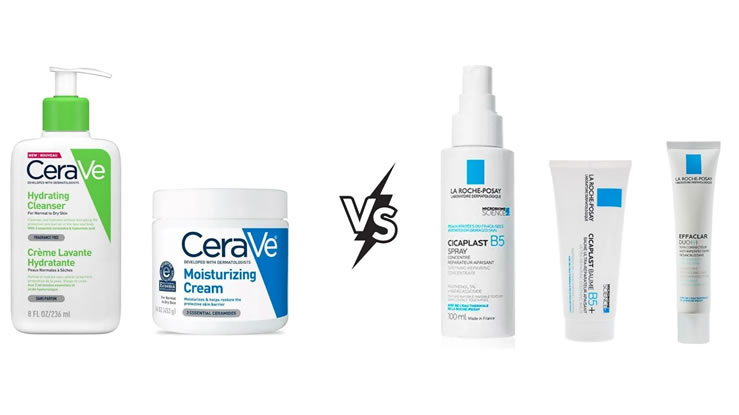
For dry skin, La Roche Posay edges ahead of CeraVe overall thanks to its Toleriane Intense Soothing Care and Cicaplast Baume B5, which provide a heavier level of repair and relief than most CeraVe equivalents. However, CeraVe wins on value, its Moisturising Cream delivers near identical barrier repair at roughly half the price. The best choice depends on your budget and how dry your skin actually is.
For dry skin, La Roche Posay is the stronger brand overall, with its richer, more occlusive formulas offering deeper relief for seriously dry and compromised skin. CeraVe, however, is the better value choice and performs almost as well for mild to moderate dryness at a significantly lower price point.
Both brands are dermatologist recommended, fragrance free, and built around barrier repair science. Both are widely available across the UK at Boots, Superdrug, and online. The real question is not which brand is better in absolute terms, it is which brand is better for your specific level of dryness, your skin type, and your budget. This guide gives you the honest, head to head answer.
What Are CeraVe and La Roche Posay?
CeraVe and La Roche Posay are two of the most widely recommended skincare brands in the UK, both sitting in the affordable to mid range price bracket and both rooted in dermatological science rather than marketing trends.
CeraVe was founded in the United States in 2005 and is built around a single core technology: MultiVesicular Emulsion (MVE), a patented delivery system that releases ceramides gradually into the skin over time. Ceramides are lipids naturally found in the skin barrier, they make up approximately 50% of the skin’s outer layer and are essential for retaining moisture and protecting against environmental damage. CeraVe products contain three specific ceramides (1, 3, and 6-II) alongside hyaluronic acid and niacinamide, designed to restore the barrier from the inside out.
La Roche Posay is a French dermatological brand founded in 1975 and built around the unique thermal spring water sourced from the town of La Roche Posay in the Vienne region of France. This water contains a high concentration of selenium, a powerful antioxidant mineral, and has a well documented soothing and anti inflammatory effect on sensitive and compromised skin. La Roche Posay products tend to use richer, more occlusive formulas than CeraVe, with a focus on intensive repair rather than maintenance hydration.
Both brands are owned by L’Oreal. Both are fragrance free across their core dry skin ranges. Both are non comedogenic. And both are recommended by dermatologists far more frequently than most premium skincare brands costing three to five times more.
How Do They Compare on Key Ingredients?
Understanding the ingredient differences helps explain why the two brands suit slightly different levels of dryness.
| Ingredient | CeraVe | La Roche Posay |
|---|---|---|
| Ceramides | Yes, ceramides 1, 3, and 6-II | Yes, in select products |
| Hyaluronic acid | Yes, across most products | Yes, across most products |
| Niacinamide | Yes, most formulas | Selected products only |
| Thermal spring water | No | Yes, La Roche Posay spring water in all products |
| Selenium | No | Yes, via thermal spring water |
| Shea butter | Selected products | Yes, Cicaplast and Toleriane range |
| Panthenol (B5) | Selected products | Yes, Cicaplast Baume B5 |
| Glycerin | Yes | Yes |
| Petrolatum | Healing Ointment only | Cicaplast range |
| Fragrance | None in core range | None in core range |
The key takeaway: CeraVe leads on ceramide delivery, which makes it particularly effective for barrier repair at a cellular level. La Roche Posay leads on occlusive and anti inflammatory ingredients, shea butter, panthenol, petrolatum, which makes it better at providing immediate, intensive relief for severely dry or irritated skin.
CeraVe vs La Roche Posay: Moisturisers for Dry Skin
The moisturiser category is where most dry skin sufferers start, and where the difference between the two brands is most clearly felt.
CeraVe Moisturising Cream
Price: approximately £12 for 340g at Boots and Superdrug
The CeraVe Moisturising Cream is one of the most recommended moisturisers in UK dermatology. It uses the MVE technology to deliver ceramides gradually throughout the day, maintaining barrier function long after application. The texture is thick enough for genuinely dry skin but absorbs well enough to be used on the face and body. It contains hyaluronic acid for hydration and niacinamide for barrier support and mild brightening.
For mild to moderate dry skin, it is difficult to beat at this price. It is also one of the most cost effective moisturisers on the UK market, at £12 for 340g, the per gram cost is extremely low compared to almost any competing product.
La Roche Posay Toleriane Intense Soothing Care
Price: approximately £18 for 40ml at Boots
The Toleriane Intense Soothing Care is La Roche Posay’s answer for dry and very sensitive skin. It is richer and more occlusive than the CeraVe Moisturising Cream, with a heavier, more emollient texture that provides a stronger physical barrier against moisture loss. It contains the La Roche Posay thermal spring water, glycerin, and shea butter, and has been specifically clinically tested on skin with compromised barriers including eczema prone skin.
For moderate to severe dry skin, or for anyone whose dryness comes with redness, sensitivity, or discomfort, the Toleriane Intense edges ahead. The price per gram is significantly higher than CeraVe, but the texture and relief it provides justifies the cost for those with genuinely problematic dry skin.
Verdict on moisturisers: La Roche Posay Toleriane Intense wins for severe dry skin. CeraVe Moisturising Cream wins on value and is the better choice for mild to moderate dryness.
CeraVe vs La Roche Posay: Cleansers for Dry Skin
Choosing the wrong cleanser is one of the most common reasons dry skin stays dry. Both brands offer gentle, gentle cleansers for dry skin but take notably different approaches.
CeraVe Hydrating Cleanser
Price: approximately £10 for 236ml at Boots and Superdrug
The CeraVe Hydrating Cleanser is a non foaming, cream format cleanser that removes makeup and daily grime without disrupting the skin barrier. It contains the same ceramide trio as the moisturiser range, along with hyaluronic acid and glycerin. Skin feels hydrated rather than tight or stripped after use, which is the key test for any dry skin cleanser.
It rinses cleanly despite the cream texture, a concern some people have with non foaming cleansers, and is gentle enough to use twice daily even on very dry skin. At £10 for 236ml, it offers exceptional value.
La Roche Posay Toleriane Hydrating Gentle Cleanser
Price: approximately £13 for 200ml at Boots
La Roche Posay’s Toleriane Hydrating Gentle Cleanser uses a micellar technology format that lifts impurities and traces of makeup from the skin without any rubbing or friction, important for dry, sensitive skin where physical disruption can trigger redness and irritation. It contains the brand’s thermal spring water, niacinamide, and glycerin, and leaves skin feeling noticeably soft immediately after use.
The La Roche Posay version is slightly more expensive and slightly smaller, but the micellar technology gives it an edge for anyone with skin that reacts to even gentle friction during cleansing.
Verdict on cleansers: La Roche Posay Toleriane Hydrating Gentle Cleanser wins for reactive and very sensitive dry skin. CeraVe Hydrating Cleanser wins on value and is excellent for most dry skin types.
CeraVe vs La Roche Posay: Body Lotions for Dry Skin
Both brands offer dedicated body products for dry skin, and this is the category where CeraVe makes the strongest case for itself.
CeraVe Moisturising Lotion
Price: approximately £14 for 473ml at Boots and Superdrug
The CeraVe Moisturising Lotion is a lighter texture alternative to the Moisturising Cream, designed for daily all over body use. It contains the full ceramide trio, hyaluronic acid, and niacinamide, absorbs quickly without greasiness, and comes in a large pump bottle that represents excellent value for money. For everyday body moisturisation on dry skin, it is hard to fault.
La Roche Posay Lipikar Baume AP+M
Price: approximately £16 for 200ml at Boots
The Lipikar Baume AP+M is La Roche Posay’s flagship body product for dry and eczema prone skin. It contains shea butter, glycerin, and the brand’s MicroResyl technology, which works by restoring the skin’s natural microbiome balance, an approach that goes beyond simple moisturisation to address one of the underlying causes of chronic dry skin and eczema. It is clinically tested for eczema prone skin and has a particularly strong reputation among patients with atopic dermatitis.
For severely dry or eczema prone body skin, the Lipikar Baume AP+M is the better choice. For everyday dry skin maintenance, the CeraVe Moisturising Lotion offers almost as much benefit at a lower cost per application given the larger volume.
Verdict on body products: La Roche Posay Lipikar Baume AP+M wins for eczema prone and severely dry skin. CeraVe wins on everyday value and convenience.
CeraVe vs La Roche Posay: Which Brand Wins for Specific Skin Concerns?
| Skin Concern | Better Choice | Recommended Product |
|---|---|---|
| Mild dry skin on a budget | CeraVe | Moisturising Cream (£12 for 340g) |
| Moderate to severe dry skin | La Roche Posay | Toleriane Intense Soothing Care |
| Dry and sensitive skin | La Roche Posay | Toleriane Hydrating Gentle Cleanser |
| Dry and acne prone skin | CeraVe | CeraVe PM Facial Moisturising Lotion |
| Eczema prone body skin | La Roche Posay | Lipikar Baume AP+M |
| Dry skin around the eyes | La Roche Posay | Toleriane Ultra Eye Cream |
| Dry skin on a student budget | CeraVe | Moisturising Cream or Hydrating Cleanser |
| Dry skin plus redness | La Roche Posay | Cicaplast Baume B5 |
| post procedure dry skin | La Roche Posay | Cicaplast Baume B5 |
| Dry skin routine, complete | CeraVe | Hydrating Cleanser + Moisturising Cream |
Can You Mix CeraVe and La Roche Posay?
Yes, and many dermatologists actively recommend it. The two brands are formulated with compatible ingredients, are both fragrance free, and are both designed for barrier repair, they complement each other rather than competing or interfering.
A popular combination recommended by UK skincare practitioners is the CeraVe Hydrating Cleanser paired with the La Roche Posay Toleriane Intense as a moisturiser. This gives you the cost efficiency of CeraVe at the cleansing step, where the texture and performance gap between the brands is smaller, and the more intensive moisturising power of La Roche Posay where it matters most.
Another widely used combination is CeraVe Moisturising Cream for the morning (lighter enough to layer under SPF) and La Roche Posay Cicaplast Baume B5 for the evening as a richer overnight treatment.
There is no reason to commit exclusively to one brand. Build your routine around what each product does best, regardless of the logo on the packaging.
What Do Dermatologists Say About CeraVe vs La Roche Posay?
UK dermatologists tend to recommend both brands interchangeably for dry skin, with a few consistent patterns.
Dr. Anjali Mahto, consultant dermatologist and author of The Skin Bible, has noted that both brands “deliver ingredients that are genuinely useful for the skin barrier at a price point that makes consistent use realistic for most patients, which is ultimately what determines whether any skincare product works.”
The British Association of Dermatologists does not endorse specific brands but consistently recommends fragrance free, ceramide containing moisturisers for dry and eczema prone skin, a description that fits both CeraVe and La Roche Posay’s core ranges precisely.
The British Skin Foundation similarly recommends moisturisers containing humectants (hyaluronic acid, glycerin), emollients (ceramides, shea butter), and occlusives (petrolatum) for dry skin management, again, a description that maps directly onto both brands.
The consistent message from UK dermatology: both brands are among the best choices available for dry skin at their price points. The choice between them is clinical rather than hierarchical, it depends on the severity of your dryness and the specific product being compared, not on one brand being categorically superior to the other.
How to Build a Complete Dry Skin Routine Using CeraVe and La Roche Posay
Based on the head to head product comparisons above, here is an evidence based dry skin routine using products from both brands:
Morning routine
Step 1, Cleanse: CeraVe Hydrating Cleanser (£10). gentle, maintains barrier integrity through the cleansing step.
Step 2, Moisturise: CeraVe Moisturising Cream (£12). Ceramide delivery under SPF. Absorbs well enough for daytime use.
Step 3, SPF: Apply a separate broad spectrum SPF 30 or higher over the moisturiser. Sun damage is the primary driver of dry, ageing skin, this step is essential.
Evening routine
Step 1, Cleanse: CeraVe Hydrating Cleanser or La Roche Posay Toleriane Hydrating Gentle Cleanser (£13). The La Roche Posay option adds extra soothing for reactive skin.
Step 2, Treatment: Apply any active treatments such as retinol or niacinamide serums here if using them. See our retinol beginners guide for more detail.
Step 3, Moisturise: La Roche Posay Toleriane Intense Soothing Care (£18) or Cicaplast Baume B5 (£12 for 40ml). The heavier textures are ideal for overnight repair when your skin does most of its recovery work.
Total cost of this full routine: approximately £50 to £55 for products that will each last 6 to 8 weeks minimum with twice daily use.
Frequently Asked Questions About CeraVe vs La Roche Posay
Q: Is CeraVe or La Roche Posay better for eczema prone skin?
La Roche Posay is generally the stronger choice for eczema prone skin, particularly the Lipikar Baume AP+M for the body and Toleriane Intense for the face. The brand’s thermal spring water has documented anti inflammatory properties, and the Lipikar range specifically addresses the microbiome imbalance associated with atopic dermatitis. CeraVe is also suitable for eczema prone skin and is the better choice when cost is a significant factor.
Q: Is CeraVe or La Roche Posay better for sensitive skin?
Both are excellent for sensitive skin, as both brands are fragrance free and dermatologist tested. La Roche Posay has a slight edge for skin that is both dry and reactive, due to the soothing properties of the thermal spring water and the anti inflammatory ingredients in the Toleriane and Cicaplast ranges. CeraVe is excellent for sensitive skin that is primarily dry rather than reactive.
Q: Which brand is better value for money?
CeraVe offers better value across almost all product categories. The Moisturising Cream at £12 for 340g is one of the most cost effective dermatologist recommended moisturisers available in the UK. La Roche Posay products are typically 20 to 40% more expensive per gram of product, though the richer formulas mean you may use less per application.
Q: Can I use CeraVe or La Roche Posay on my body as well as my face?
Yes. Both brands formulate products specifically for body use, and several products in both ranges are suitable for face and body. The CeraVe Moisturising Cream and La Roche Posay Toleriane Intense are both approved for face use; the CeraVe Moisturising Lotion and La Roche Posay Lipikar Baume AP+M are designed primarily for body use but are gentle enough for the face if needed.
Q: Are CeraVe and La Roche Posay available in the UK?
Yes. Both brands are widely available in the UK at Boots, Superdrug, ASOS, Lookfantastic, and Amazon UK. Boots and Superdrug carry the largest in store selections and regularly run promotions on both brands, CeraVe in particular is frequently available on 3-for-2 offers at Boots.
Q: Which brand is better for dry skin on the face specifically?
For the face specifically, La Roche Posay edges ahead for moderate to severe facial dryness due to its richer formulas and the soothing effect of the thermal spring water. CeraVe is the better choice for mild facial dryness and for layering under SPF or makeup during the day, as its textures are lighter and absorb more readily.
CeraVe and La Roche Posay are both outstanding choices for dry skin, the best affordable dermatological skincare brands available in the UK in 2026. For mild to moderate dry skin on a budget, CeraVe is the clear winner. For moderate to severe dry skin, reactive skin, eczema prone skin, or anyone who wants the most intensive repair available without a prescription, La Roche Posay is worth the extra cost. And for the best of both worlds, mix them: CeraVe for cleansing and daytime moisturising, La Roche Posay for intensive evening repair.
Related articles on Glow Cosmetology
The 7 Best Retinol Serums for Beginners in the UK 2026
Which is better, Cetaphil or CeraVe